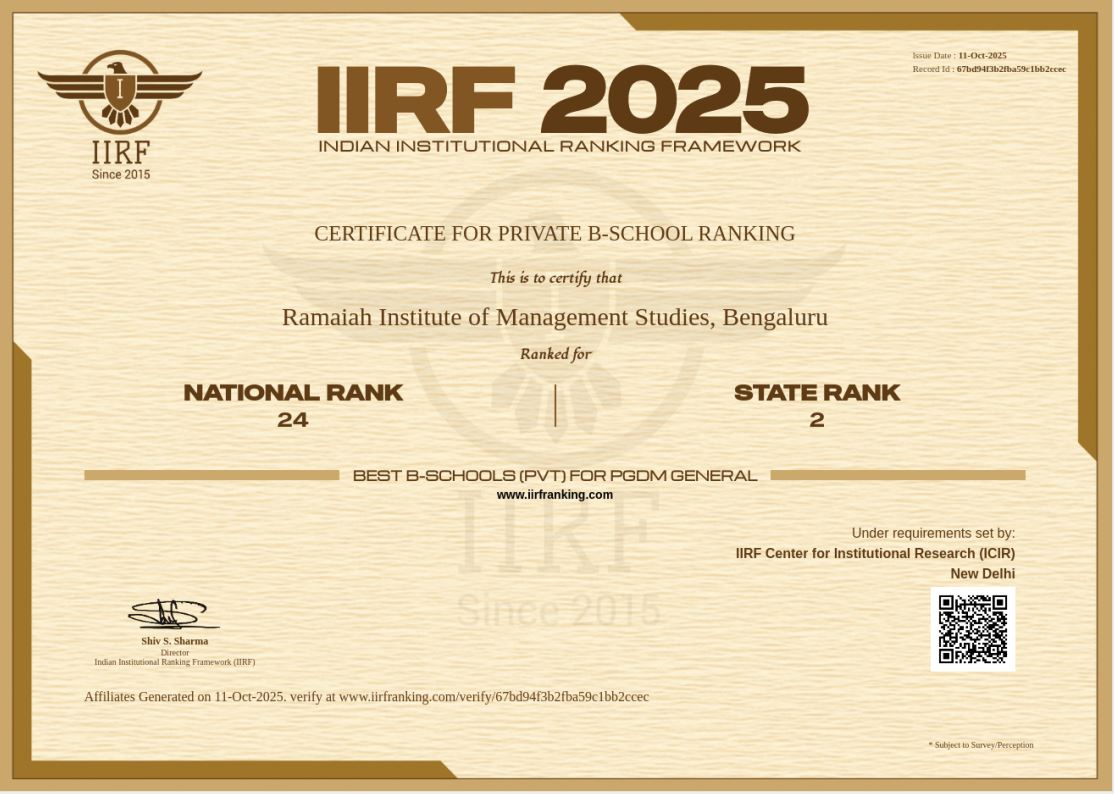

NEW!   Admissions Open for the New Academic Year   NEW!   RIMS PGDM students will get an additional certification course from Grant Thornton with addition to KPMG Certification.   NEW!   Tie - Up with Toastmasters International to enable students to improve their public speaking skills.   NEW!   Education loan for meritorious students is available under PM Vidyalaxmi scheme (https://pmvidyalaxmi.co.in)

Author name: admin

Navigating the Paradox: Exploring the Role of AI, ChatGPT, and Candidate Empowerment in Addressing the Unemployment Employability Conundrum

Author: Dr. S Murali; Associate Professor Department: Management (AICTE PGDM) RIMS, Gokula, Bangalore In todays rapidly evolving global economy, the intersection of technological advancement and workforce dynamics presents a paradoxical challenge: rising unemployment rates alongside decreasing employability skills among candidates. This article delves into the complexities of this conundrum, examining the roles of Artificial Intelligence (AI), ChatGPT, and candidate empowerment in shaping the future of employment. The Impact of AI and ChatGPT: AI and ChatGPT represent groundbreaking innovations that have revolutionized industries, reshaping job roles and processes. While these technologies offerunprecedented opportunities for efficiency and productivity, they also raise concerns about job displacement and skill obsolescence. The automation facilitated by AI and ChatGPT threatens traditional employment avenues, particularly in sectors susceptible to mechanization. Unpacking the Employability Skills Gap:In tandem with technological disruption, the declining employability skills among candidates exacerbate the challenges posed by unemployment. Employers increasingly lament the shortage of essential skills such as critical thinking, communication, and adaptability among job applicants. This skills gap underscores the inadequacy of current education and training systems in preparing individuals for the demands of the modern workplace. Blame Game or Systemic Issue? While some attribute the rise in unemployment and skills mismatch to the proliferation of AI and ChatGPT, others argue that systemic issues within education, training, and workforce development systems are the root causes. Rather than assigning blame to specific technologies or individuals, it is crucial to adopt a nuanced  perspective that acknowledges the multifaceted nature of the challenge. Empowering Candidates for Success:Central to addressing the unemployment-employability conundrum is the empowerment of candidates through targeted interventions. Investing in lifelong learning initiatives, reskilling programs, and mentorship opportunities can equip individuals with the skills and competencies needed to thrive in a dynamic job market. By fostering a culture of continuous learning and professional development, candidates can adapt to evolving industry trends and navigate career transitions effectively. Redefining Education and Training Paradigms: To bridge the gap between education and employment, it is essential to reimagine traditional education and training paradigms. Collaborative efforts between educational institutions, employers, and policymakers are needed to design curricula that are aligned with industry needs. Practical, experiential learning opportunities should be integrated into educational programs to ensure that graduates possess the practical skills and knowledge required for workplace success. The Role of Government and Industry: Governments play a pivotal role in facilitating the transition to a future-ready  workforce. Policies aimed at incentivizing skill development, promoting entrepreneurship, and fostering innovation can create an enabling environment for economic growth and job creation. Similarly, industry stakeholders must actively engage in initiatives to support workforce development, including apprenticeship programs, internships, and vocational training partnerships. At Ramaiah Institute of Management Studies (RIMS), we are committed to preparing our students for success in the ever-evolving job market by equipping them with the necessary employability skills. Through a combination of rigorous academic curriculum, experiential learning opportunities, and industry-oriented training programs, we strive to bridge the gap between education and employment. Our dedicated faculty members, industry partnerships, and state-of-the-art infrastructure ensure that students receive holistic development, encompassing not only theoretical knowledge but also practical skills and real-world experience. By fostering a culture of innovation, entrepreneurship, and lifelong learning, RIMS empowers students to thrive in dynamic work environments, thus contributing to the reduction of the unemployment gap and shaping a future workforce that is skilled, adaptable, and ready to take on the challenges of tomorrow. In conclusion addressing the unemployment-employability conundrum requires a collaborative effort involving government, industry, educational institutions, and individual candidates. Rather than succumbing to a blame game, stakeholders must work together to harness the transformative potential of technology while ensuring that no one is left behind. By empowering candidates with the skills, knowledge, and opportunities they need to succeed, we can navigate the challenges of the future of  work and build a more inclusive and resilient society. Put your comments at [email protected]

Navigating the Paradox: Exploring the Role of AI, ChatGPT, and Candidate Empowerment in Addressing the Unemployment Employability Conundrum Read More »

The superpower you did not know you had: unleashing the magic of EmotionalIntelligence.

Author : Dr. Rekha N Assistant Professor – Human Resource Hey there savvy readers! superpower that’s often underestimated but holds the key to success, happiness, and ninja-level social skills – Emotional Intelligence (EI). Buckle up, because we’re about to discover why this magical skill isn’t just a tool for career wizards but an essential potion for brewing a delightful life. Imagine you are in a café and suddenly someone spills their latte all over your freshly trending  newly purchased dress. How do you react? A) Burst on them and demand for compensation B) Smile and let it go C) Politely address the situation and find a solution  If you answered b or c, congratulations! You might just be riding the EQ train. But if you have picked A don’t worry there is always scope for improvement and let’s dive together on the journey to embark the real of Emotional Intelligence (EI)  The Basics of Emotional Intelligence So, what exactly is Emotional Intelligence? Picture it as the secret sauce that makes your  interactions with the world a lip-smacking success. EI is the ability to understand and manage  your own emotions while navigating the emotional landscapes of those around you. It’s like  having a radar that detects feelings, a GPS for empathy, and a Jedi-level control over your  emotional spaceship. EI in Action: More Than Just a Career BoosterSure, you might have heard that emotional intelligence is crucial for climbing the corporate ladder, but guess what? It’s not just about landing that dream job or sealing the deal. It’s the Xfactor that transforms your daily life into a symphony of harmonious relationships, vibrant mental health, and pure, unadulterated awesomeness. 1)Relationships: Because Who Doesn’t Love a Social Butterfly? Imagine being the social butterfly who effortlessly flits from one social gathering to another, leaving a trail of laughter and warmth. That’s the magic of EI! Understanding others’ emotions and responding appropriately can turn you into a magnet for positive connections. It’s not about being a people-pleaser; it’s about forging genuine connections that withstand the test of time.2)Mental Health: Taming the Emotional Rollercoaster Life is a rollercoaster, and emotions are the loops and turns. With a high EI, you become the master of the ride, navigating the twists with grace. Recognizing and managing your own emotions prevents stress, anxiety, and burnout. It’s like having a mental fitness regimen that keeps you in the peak of emotional well-being.3)Self-Awareness: The Blueprint to Personal Growth Ever wanted a manual for understanding yourself better? Look no further – EI is your personalized blueprint for self-awareness. It’s the tool that helps you identify your strengths and weaknesses, paving the way for continuous self-improvement. Who needs a superhero cape when you have the power to shape your own destiny? Now, let’s talk about why EI is not just a nice-to-have but a must-have for the young guns navigating the digital era

The superpower you did not know you had: unleashing the magic of EmotionalIntelligence. Read More »

Unveiling the Relevance of Fintech 5.0 in Today’s Dynamic Financial Landscape

Author – Lokesh.Y.R, Asst. Professor, Deparment of Management, RIMS In the rapidly evolving landscape of finance, the convergence of technology and financial services has given birth to what we now know as Fintech – a term that encompasses innovations ranging from mobile payment systems to Block chain technology. As we venture into the era of Fintech 5.0, the financial ecosystem is transformed into dynamic platform that enables the user to get his services are rendered immediately. In this Blog Post we will try to understand the significance of Industry Fintech 4.O and its transformation to Fintech 5.O. Understanding Fintech 4.0 and 5.0: Fintech 4.O the term in the early 2011 that bought the freshness in finance and banking industry a great wave where computers and technology started operating without humans intervention that aims to automate and optimize processes through the use of smart technologies, Industry Fintech 4.O represents the paradigm shift from the traditional financial services to digital platforms using various tools like AI, Machine learning, Big data Analytics, Cloud Computing and other technology driven systems in financial infrastructure. This lead to enhance the operational efficiency, manage the risk and enhance the customer experience on real time basis. Since the above mentioned technologies started to gain popularity, Customer and Industry was missing something which was lacking to make 4.O more effective that’s why 5.O was initiated in the year of 2018, This transition was driven by continuous development of technology that made customers to bring much more near to the financial services using various advanced robotics and  smart technologies resulted in the birth of Industry 5.O era. There are many factors those contribute in this transition as follows: 1)Emergence of advanced technologies like Internet of Things(IOT), Augmented Reality(AR), Virtual Reality(VR), Quantam Computing and Robotics These advanced technologies enable deeper integration of finance with other sectors to make them more efficient and user friendly,unlocking new business models, and enhance the capabilities of financial services available across the globe. 2)The finance industry was compelled to update from 4.O to 5.O owing to a paradigm shift toward hyper-personalization of services and fascinating experiences, which was demanded by clients. This change is a reflection of the rising need in the evolving digital environment for personalized financial solutions and improved user experiences. 3)Economic Integration: Fintech 5.0 focuses for ecosystem integration, where finance interfaces with many sectors like healthcare, retail, transportation, and real estate. The result goes beyond standalone financial services and was a major factor in the switch from 4.O to 5.O. Fintech 5.O sets up fresh opportunities for the creation of value and collaboration between sectors by integrating financial services into common experiences and transactions. 4)The principles of Web 3.0 and decentralized finance (DeFi) have been adopted by Fintech 5.O, that employs blockchain and smart contracts to simplify peer-to-peer transactions, automate banking processes and do away with intermediaries. The banking and finance sector is becoming more equitable, transparent, and productive as a result of this paradigm shift towards these decentralized, trustless systems. Overall, the transition from Fintech 4.0 to Fintech 5.0 symbolizes the financial services industry’s solid commitment to innovation, efficiency, and customer-centricity, propelled by technology’s transformative power and its necessity of adjusting to a world that is becoming increasingly digital and internationally connected. The Implications of Fintech 4.O and 5.O: 1)Enhanced Customer Experience : Fintech 4.O and 5.O both strives hard to leverage the advanced smart technologies to fulfil the requirements of its targeted customers through customized financial services starting from Chatbots providing real time assistance to VR Reality for pleasant banking experience. 2)One of the most potential of this updation is financial inclusion as by leveraging the smart technologies in the business and other finance arenas, Bigger populated countries like India will be benefitted magnificently. For Example : These days the biometric based identity cards are encapsulated with all other required documents as they are easy to process and arrive at the end results.(Like linking adhar and Pan, Adhar and Mobile number, Pan and Demat, Adhar and Demat, etc..,) 3)Since the updation was mandate and required, traditional banking participants had to struggle a lot in facing competition from finance based startups and tech giants entering the financial services with huge capital (Like Jio Finance). As 5.O started to flourish , It enabled the new comers into the market and offer the products and services at lower cost challenging the big conglomerates from prompting them to indulge in unnecessary panic creation and risk management measures. 4)Fintech 5.O enables the users to be free from the worries of Cyber threats, encryption breaches and makes sure that all the stakeholder of finance sector are adhering the rules and regulations that are laid by the regulatory authorities and utmost priority is given for data security and protection for all kinds of financial security from the advanced security systems of 5.O. 5)Fintech innovations are having high impact on capital markets by making ease for investment opportunities, automated transactions, peer to peer lending, crowd funding and other Fintech based services with the help of various clearing houses and custodian banks that reduces the transaction costs and helping to increase the market efficiency. 6)Fintech 5.O leads a strong way to strengthen the ethical and environmental implications laid bythe regulatory authorities on finance industry right from basic most function till the major finance affair is taken care by various AI driven technologies to ensure that the stakeholders are benefitted through the various recent technologies.The Advent of Fintech 5.O will be a revolution in the new era of innovation, disruption and various opportunities in the financial services industry. By employing the power of advanced technologies the stakeholders will be able to unlock the new sources of value creation, empower financial inclusion to all the communities. However, realizing the potential of Industry Fintech 5.O we all stakeholders require using it to the upliftment of financial industry to compete in the global arena and also much care to be given for security, regulatory and ethical challenges that might arise in this great transition. So that we all together will be able to enjoy the sustainable financial ecosystem in the

Unveiling the Relevance of Fintech 5.0 in Today’s Dynamic Financial Landscape Read More »

“The Art of Mutual Funds: Investing Beyond the Numbers”

Author – Prof S Siddharth Assistant Professor Introduction: In the bustling world of finance, where numbers and data often dictate decisions, lies a beacon of collaborative investment – Mutual Funds. Often misunderstood as mere collections of stocks or bonds, Mutual Funds embody a unique amalgamation of investor aspirations, market insights, and the art of diversification. In this blog, we delve into the depths of Mutual Funds, uncovering their essence beyond the conventional analysis, exploring the human touch that defines their uniqueness. Understanding Mutual Funds: At its core, a Mutual Fund represents a pooling of resources from various investors with a common objective – to achieve financial growth. However, what sets Mutual Funds apart is the meticulous craftsmanship behind their construction. Fund managers, akin to skilled artisans, meticulously curate portfolios, blending diverse assets to create a tapestry of investment opportunities. The Human Touch: Contrary to popular belief, Mutual Funds are not just about numbers and algorithms; they encapsulate human intuition and foresight. Fund managers act as custodians of investors’ trust, navigating through market volatilities with a blend of expertise and instinct. Their decisions reflect not only financial acumen but also a profound understanding of investor sentiments and market dynamics. Diversification: The Canvas of Opportunities: One of the key tenets of Mutual Funds is diversification – spreading investments across various asset classes, sectors, and geographic regions. This not only mitigates risks but also unlocks a universe of opportunities. Like an artist with a palette of colours, fund  managers craft portfolios that capture the essence of global markets, painting a picture of resilience and growth. Empowering Investors: Mutual Funds epitomize the democratization of investing, offering access to sophisticated strategies and asset classes that were once reserved for institutional investors. Through Mutual Funds, individuals can embark on a journey of wealth creation, guided by seasoned professionals who navigate the complexities of the financial landscape on their behalf. Community and Collaboration: Beyond its financial merits, Mutual Funds foster a sense of community and collaboration among investors. Whether it’s through mutual support forums or shared experiences, investors find solace and strength in collective wisdom. Mutual Funds transcend individual gains, fostering a culture of shared prosperity and mutual growth. The Evolution of Responsible Investing: In recent years, Mutual Funds have embraced a new paradigm – responsible investing. Beyond the pursuit of profits, fund managers now consider environmental, social, and governance (ESG) factors in their investment decisions. This shift not only aligns investments with societal values but also underscores the transformative power of Mutual Funds in shaping a sustainable future. Conclusion: Mutual Funds are more than just financial instruments; they are a testament to the symbiotic relationship between investors, fund managers, and the market. With their blend of human insight, diversification, and collaborative spirit, Mutual Funds redefine the art of investing. As we navigate the complexities of the financial world, let us remember that behind every Mutual Fund lies a story of aspiration, innovation, and the enduring pursuit of prosperity.

“The Art of Mutual Funds: Investing Beyond the Numbers” Read More »

Effect of Placebo in RIMS

Author – Dr.M.Swapna Principal, RIMS, Bangalore “The placebo effect is the effect of an inert substance on your brain and behavior,” psychology teacher Melinda Mattes said. “It’s when you have a belief that something will work, not because of the actual thing.”The Harvard study reveals that the placebo effect involves a reaction in the brain which can cause a release of chemical substances including endorphins and dopamine. This can subsequently affect brain regions that are related to mood, behaviour and self-awareness, all of which can have therapeutic benefits. According to Ted Kaptchuk, a Harvard professor whose studies concentrate on the placebo effect, this reaction is not only psychological but also biological.At RIMS Professors Motivate and encourage in order to facilitate students’ learning and development which acts as a placebo. As a Professor, we praise our students generously instead of noticing their mistakes and pointing them out. Which has proved to encourage them to speak more in class which is a determining factor for improving confidence and communication. It is a fact that praise is retained longer in human memory and students mostly remember the Professor who praised rather than the ones who criticized. RIMS enable students to feel that they are improving which has a placebo effect which can have a real impact on the student’s learning in the long term. Japanese scientist, Masaru Emoto performed some of the most fascinating experiments on the effect that words have on energy in the 1990’s. When frozen, water that’s free from all impurities will form beautiful ice crystals that look exactly like snowflakes under a microscope. Water that’s polluted, or has additives like fluoride, will freeze without forming crystals. In his experiments, Emoto poured pure water into vials labelled with negative phrases like “I hate you” or “fear.” After 24 hours, the water was frozen, and no longer crystallized under the microscope: It yielded grey, misshapen clumps instead of beautiful lace-like crystals. In contrast, Emoto placed labels that said things like “I Love You,” or “Peace” on vials of polluted water, and after 24 hours, they produced gleaming, perfectly hexagonal crystals. Emoto’s experiments proved that energy generated by positive or negative words can actually change the physical structure of an object. The results of his experiments were detailed in a series of books beginning with The Hidden Messages in Water, where you can see the astounding before and after photos of these incredible water crystals. Similarly, at RIMS we have seen tremendous transformation in students through our customised individual student centric learning and development which gives lot of confidence to students and has a positive impact on their career.

Effect of Placebo in RIMS Read More »

Decoding Millennial Brand Loyalty: Can AI Unlock the Secret to AuthenticMessaging?

Author – Prof.Srinivas Prabhu,RIMS,Bangalore. In a world overflowing with ads, slogans, and carefully crafted brand personas, there’s one group of consumers who see right through the noise: millennials. This generation, born into the digital age, is notoriously resistant to traditional marketing tactics. They value authenticity above all else and have a finely tuned detector for anything that feels fake or manipulative. So, how can brands establish genuine connections and foster lasting loyalty with this influential cohort? The answer might lie in a surprising place: the power of generative artificial intelligence (AI). The Challenge of Marketing to Millennials Millennials, roughly those born between 1981 and 1996, have grown up with unprecedented access to information and choices. They’re not easily swayed by flashy campaigns or empty promises. They want brands that align with their values, embrace transparency, and engage them in meaningful conversations. Yet, many businesses still rely on outdated marketing strategies designed for a bygone era. Superficial messaging, hyperbolized claims, and an overemphasis on selling rather  than connecting often backfire with this audience. In fact, studies show that a  significant portion of millennials actively distrust traditional advertising, making it  increasingly difficult to capture their attention and trust. AI to the Rescue: Understanding the Language of Authenticity This is where generative AI enters the picture. Large language models (LLMs), like GPT-3 and its successors, have made remarkable strides in understanding the nuances of human communication. By analyzing vast datasets of text and code, these AI models can learn to identify patterns of language that resonate with specific audiences, predict emotional responses, and even generate their own creative content. Imagine an AI tool specifically trained on a massive collection of millennial interactions with brands on social media. This tool would have an unprecedented ability to: 1) Dissect the Linguistic Markers of Authenticity: What kind of words, phrases, and conversational styles make millennials feel seen and understood? 2)Measure Sentiment with Precision: Going beyond simple “positive” or “negative,” detecting complex emotions like trust, skepticism, or enthusiasm in social media exchanges. 3)Predict Brand Loyalty Potential: Understanding the subtle cues within an online conversation that signal a likelihood of a consumer becoming a loyal brand advocate.   AI to the Rescue: Understanding the Language of Authenticity The research proposal we outlined explores the development of just such a tool.Here’s how it breaks down: 1)Data is King: The foundation of this project is a massive dataset of millennial social media conversations. This includes their posts, comments, shares, and direct interactions with brands across various platforms. Alongside this, we collect a range of existing brand messaging – everything from ad copy to influencer content. 2) AI Training: The AI model is fine-tuned on this meticulously curated dataset, learning to recognize the linguistic and emotional fingerprints of authentic brand engagement for this specific demographic. 3)Generative Power: The model isn’t just about analysis; it’s about creation. It can generate multiple variations of social media content optimized for millennial  sensibilities. Crucially, these variations are not mere copycatting; they demonstrate a deep understanding of what makes messaging feel genuine. 4)User-Friendly Dashboard: Data scientists aren’t the target audience here – marketers are. An intuitive interface allows users to input existing messaging and receive AI-generated alternatives, along with predicted sentiment scores and a “loyalty potential” indicator. Developing an AI-Powered Authenticity Engine The research proposal we outlined explores the development of just such a tool. Here’s how it breaks down: 1. Data is King: The foundation of this project is a massive dataset of millennial social media conversations. This includes their posts, comments, shares, and direct interactions with brands across various platforms. Alongside this, we collect a range of existing brand messaging – everything from ad copy to influencer content. 2. AI Training: The AI model is fine-tuned on this meticulously curated dataset, learning to recognize the linguistic and emotional fingerprints of authentic brand engagement for this specific demographic. 3. Generative Power: The model isn’t just about analysis; it’s about creation. It can generate multiple variations of social media content optimized for millennial sensibilities. Crucially, these variations are not mere copycatting; they demonstrate a deep understanding of what makes messaging feel genuine. 4. User-Friendly Dashboard: Data scientists aren’t the target audience here – marketers are. An intuitive interface allows users to input existing messaging and receive AI-generated alternatives, along with predicted sentiment scores and a “loyalty potential” indicator. Ethical Considerations: Transparency and Bias-Busting The potential of AI in this context is immense, but it’s crucial to address ethical concerns head-on.● Data Privacy: Anonymization of user data and adherence to the highest privacy standards are non-negotiable.● Transparency: Users of this technology must be open about the role of AI incontent generation, building

Decoding Millennial Brand Loyalty: Can AI Unlock the Secret to AuthenticMessaging? Read More »

INSTITUTION’S INNOVATION COUNCIL – IMPACT LECTURE SERIES On METAVERSE RETHINKING REVENUE On 22-July-2022

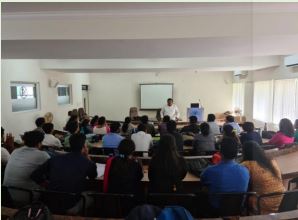
Speaker addressing to the students The event was co-ordinated by the Faculty Co-ordinator Dr. Dhanalakshmi K and Student Co-ordinators Mr. Deepak Kumar and Ms. Preethika, First Year PGDM Students, respectively. Ms. Meenakashi Patil Global Lead – Strategic Partnerships at IBM The program began with an introductory address on Institution’s Innovation Council by Mr. Deepak Kumar, First year Student, PGDM. The speaker of the day Ms. Meenakshi Patil was introduced by Ms. Preethika, First year Student. She addressed the students gathering, that most of the corporates like Markzuckberg, J. P. Morgan, Goldmansachs, Citibank are staggering the revenue  $ 2.5 million, $ 500 million, $ 8 trillion and $ 13 trillion, respectively and J. P. Morgan invested $ 500 million in virtual real estate in 2021. The present world was evolving through AR (Augmented Reality) and Virtual Reality (VR) and currently they are working on (XR) i.e., Extended reality and Digital Twin Experience.She outlined on the new internet rules are Connection, Commerce, Consent, Collaborations, Community, Copresence and now the trend is on Co-reality. She briefed on Metaverse elements, viz., Immersion, Communities, Persistence, Decentralisation, Virtual Economies and Interoperability. Metaverse is associated with multiple technologies, AI, cloud computing, SSI (Self Sovereign Identity) and DID (Decentralized Identifiers).She concluded stating the future of Metaverse in Spatial Community, Persistent Environment, Spatial Computing, Digital Identity and virtual Economy. She also shared her experiences with the students about her clients and motivated students. She explained with some examples like Gucci and students responded with some more examples of Hyundai and Nike. Dr. Swapna, Principal presenting the memento to the guest Students and faculty members with the speaker

INSTITUTION’S INNOVATION COUNCIL – IMPACT LECTURE SERIES On METAVERSE RETHINKING REVENUE On 22-July-2022 Read More »

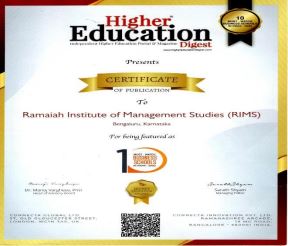
“RIMS adds another feather in the cap” Higher Education Digest Publishes RIMS as 10 MUST WATCH BUSINESS SCHOOL IN INDIA – 2022

Ramaiah Institute of Management Studies (RIMS): Creating Better Employability Opportunities in the Management Education Domain Please Find the Link Below. https://www.highereducationdigest.com/ramaiah-institute-of-management-studies-rims-creating-better-employability-opportunities-in-the-management-education-domain/ Today, with accelerated globalization, organizations experience massive pressure from various key stakeholders of the business environment. In fact, the dynamism in this environment has led to a rise in opportunities and threats to businesses. Thus there is a dire need for skilled resources to effectively address the challenges encountered by modern-day businesses. This need generated has institutes beginning to increasingly specialize in management education. This degree is viewed as a launchpad into the corporate world and is constantly evolving. To stay ahead of the dynamic and competitive global economy, experts must understand and accept the need for up-gradation. The various complexities that come with future market trends need to be incorporated into the management education framework to maintain relevancy. Perfectly poised in the business education domain is the Ramaiah Institute of Management Studies (RIMS), a division of the M S RAMAIAH Foundation. MSRF was founded with the vision to be a global centre of learning to evolve competent human resource assets with professional skills, ethics, and personal values. “Our mission is to provide a comprehensive learning experience to develop our students to be the most preferred products by the corporate. RIMS is one of the top management colleges in Bangalore that offers an AICTE approved Post Graduate Diploma in Management (PGDM) program,” says Dr. M. R. Pattabiram, Founder Trustee, M. S. Ramaiah Foundation and Director of Ramaiah Institute of Management Studie Dr. M. R. Pattabiram, Founder Trustee, M. S. Ramaiah Foundation and Director of Ramaiah Institute of Management Studies (RIMS) Dr. Pattabiram walks us through the state-of-the-art facilities the institute has to offer. The campus is sprawled with well-designed classrooms equipped with air conditioners and overhead projectors. In addition to the regular classrooms, RIMS also has smart classrooms that facilitate computer-based learning. The entire campus has access to the Internet via a 100Mbps dedicated Internet connection. So, in tandem with a smooth internet connection, the cutting-edge computer labs with the latest hardware and software help students enhance their learning capabilities. RIMS continually strives to stay ahead of the trending technology waves. The institute firmly believes that emerging technologies such as Industry 4.0, BlockChain, Data Analytics, Artificial Intelligence, Machine Learning, Design Thinking, 3D printing, and so on can disrupt businesses around the world. Keeping in mind that these will be the in-demand skills of the future, RIMS is exposing students to these technologies through guest lectures, seminars, and workshops. In addition, RIMS is also imparting a Data Analytics course to students across three semesters to enhance their employability and be ready for the future. The campus boasts a well-stocked library with more than 10000 National and International volumes of management books, journals of National and International importance, and an EBSCO database to facilitate research. Events of academic nature are held at an impressive Seminar Hall that has complete audio-visual facilities. Catering to every type of student and their needs, the institute has disabled-friendly infrastructure such as entry/exit ramps and disabled-friendly toilets. Students from outside Bangalore are housed in very comfortable hostels that are very close to the campus, and students are taken care of very well at the hostel by wardens and faculty members who also double up as their guardians. “The RIMS campus has been aesthetically designed to provide the right ambience for teaching-learning and create a home away from home for the students who come to RIMS from across the country. We boast of a highly diverse ethnic environment, and our students get an insight into the life and culture of different regions of India via cultural activities that reflect the diversity of the country,” adds Dr. Pattabiram.

“RIMS adds another feather in the cap” Higher Education Digest Publishes RIMS as 10 MUST WATCH BUSINESS SCHOOL IN INDIA – 2022 Read More »

INSTITUTION’S INNOVATION COUNCIL – IMPACT LECTURE SERIES ON LEAN CANVAS MODEL : ENTREPRENEURSHIP on 26-July-2022

Prof. Charmaine Gangen Founder and Chair : First Global Entrepreneurship Catalyst Symposium 2022 Global Entrepreneurship Education Consultant and Founder and CEO – CGM Training and Consulting The program began with an introductory address on Institution’s Innovation Council by Mr. Deepak Kumar, First year Student, PGDM. The speaker of the day Prof. Charmaine Gangen was introduced by  Ms. Preethika, First year Student. Prof. Charmaine began with note on the introduction on the concept of Entrepreneurship and few terminologies which are significant in the process of preparing Lean Canvas. She briefed on the nine grid cells of Lean Canvas and elucidated on the difference between Lean Canvas and Business Model Canvas, significance on the usage of Lean Canvas Model in the preparation of Business Plan. She illustrated her own example on the usage of Lean Canvas. The event was co-ordinated by the Faculty  Co-ordinator Dr. Dhanalakshmi K and Student Co-ordinators are Mr. Deepak Kumar and Ms. Preethika, First Year PGDM Students, respectively.

INSTITUTION’S INNOVATION COUNCIL – IMPACT LECTURE SERIES ON LEAN CANVAS MODEL : ENTREPRENEURSHIP on 26-July-2022 Read More »

Scroll to Top
Call us